[Popular Science] Selection description of helical gear planetary reducer
In the fields of industrial automation, robotics and precision control, motors are core actuators, and their stable operation and precise control are crucial to the performance of the entire system.
However, the motor may encounter a sudden power outage during operation, which will cause the motor to lose driving force and stop at the current position, or even cause position offset in some cases.
Therefore, the position recovery mechanism after the motor loses power has become a key technical issue. This article will explore the principle mechanism of motor position recovery after power failure based on the absolute encoder built into the integrated motor, in order to provide a reference for research and application in related fields.
1. Position offset after the motor loses power
When the motor loses power suddenly, due to factors such as inertia, load influence, and mechanical structure clearance, the motor's rotor may continue to rotate for a distance before stopping, or move in the opposite direction due to the reverse effect of the load, resulting in position offset.
This position offset is unacceptable for systems that require precise position control, so measures must be taken to recover.
2. Basic principles of position recovery after motor power failure
The basic principle of position recovery after motor power failure is that after the motor is powered on again, the current position of the motor is determined in some way and the motor is driven back to the preset starting position or safe position. This process involves the coordinated work of position detection, control algorithm, mechanical structure and other aspects.
3. Mechanism of position recovery after motor power failure
1. Position detection mechanism
Position detection is the first step in position recovery after motor power failure. During the power failure of the motor, traditional position detection elements (such as incremental encoders) may not work properly, so other methods are needed to determine the position of the motor.
Absolute encoder
The absolute encoder can save the current position information when the power is off. When the power is restored, the controller reads the position data in the encoder and directly determines the position of the motor.
Mechanical limit switch
When the limit switch is installed on the mechanical structure, when the motor touches the switch, a signal is triggered, indicating that the motor has reached a certain position. By reading these signals, the current position of the motor can be indirectly inferred.
Magnetic encoder or magnetic sensor
The position of the motor is detected by the change of the magnetic field. When the motor is powered off, the magnetic encoder or magnetic sensor can keep a memory of the magnetic field change, thereby providing position information after the power is restored.
2. Control algorithm mechanism
After determining the current position of the motor, a control algorithm is needed to drive the motor back to the preset position. The choice of control algorithm depends on the type of motor, load characteristics, and system requirements.
Open-loop control
For open-loop control motors such as stepper motors, pulse signals can be sent to drive the motor to perform single-step motion. After the motor loses power, the pulse signal needs to be sent again to make the motor move gradually to the preset position.
Closed-loop control
For closed-loop control motors such as servo motors, the position of the motor can be detected in real time through an encoder or sensor, and the detected position can be compared with the preset position. The motor movement can be adjusted through the control algorithm to make the motor reach the preset position accurately.
Note: All our integrated motors have built-in absolute encoders.
Fourth, the description of the position recovery after the motor is powered off
Here we only discuss the principle mechanism of the absolute encoder motor position recovery after power off
1. The position change can be accurately recorded during the motor power-on process
2. After the motor is powered off, the position at the time of power off is 0°, and the rotation range of the motor shaft does not exceed plus or minus 180°. After powering on again, the motor can be updated to the accurate position value
3. If the rotation range of the motor shaft exceeds 180° after the motor is powered off, the position after power on will be lost as a full circle (10000)
For example:
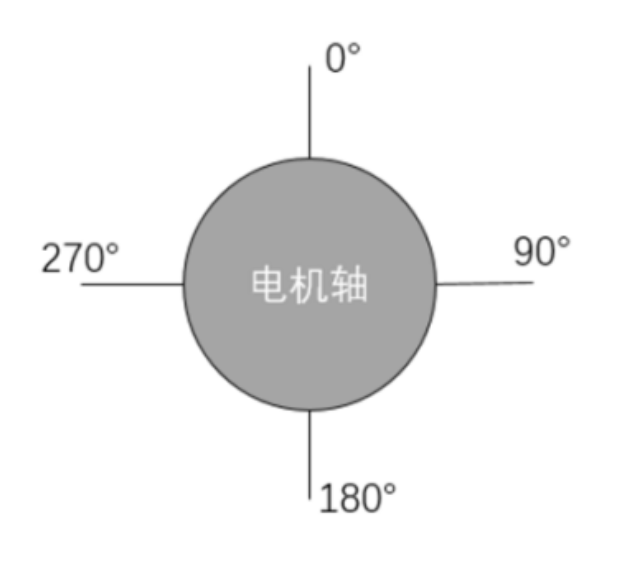
As shown in the figure, assume that the position is 0 and the angle is 0° when the power is off
1. After the power is off, the motor shaft rotates to 90° (counterclockwise or clockwise, or many turns), and the position after power is 2500
2. After the power is off, the motor shaft rotates to 270° (counterclockwise or clockwise or many turns), and the position after power is -2500
3. The position count after the motor is powered off is always within -5000 and 5000