Application case of integrated servo motor in flash tester

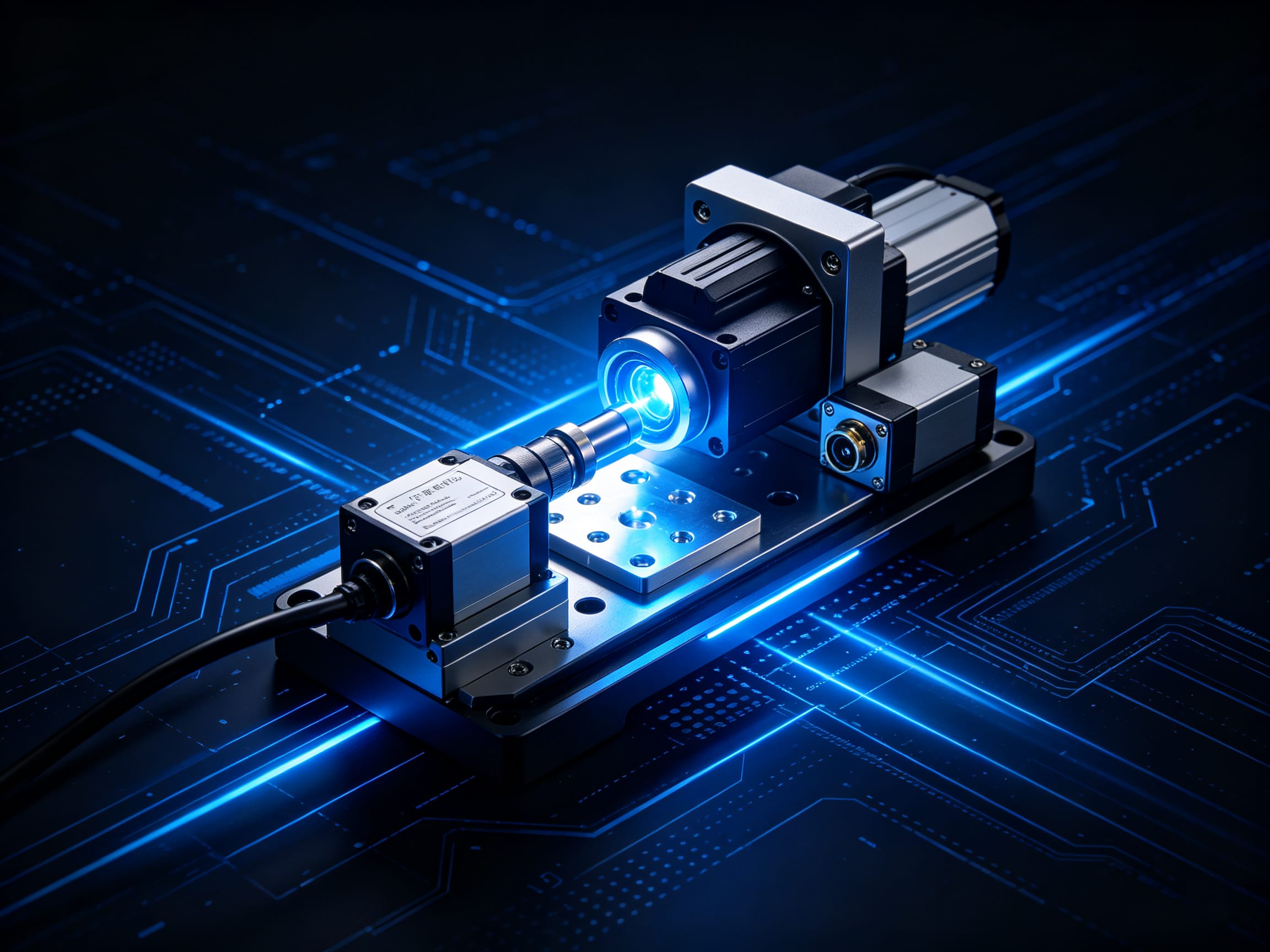
In the field of precision dimensional inspection, flash measuring instruments place extremely high demands on the positioning accuracy and stability of motion control. Using the PMM60L integrated servo motor, the system achieves high-precision positioning through pulse control, resolving positioning jitter caused by interference from multiple closed-loop systems and providing an innovative solution for motion control reliability in optical measuring equipment.
1. Device Introduction
This flash tester is primarily used for efficient dimensional inspection of industrial parts. Core requirements include:
1. Positioning Accuracy: Repeatability error ≤ ±1μm;
2. Dynamic Response: Compatible with 5V pulse signal input;
3. Stability: No residual vibration after positioning.
2. Application Solutions and Products


• Motor Model: PMM6020B-L-0HEB (Customizable 5V Input Version)
• Control Mode: Nimotion Position Mode (Pulse Control)
• System Architecture: Dual system: Full closed-loop (grating feedback) + semi-closed-loop (encoder feedback).
Technical Solution Optimization:
• Hardware Customization: Modify the signal input circuit to adapt to 5V pulses;
• Firmware Upgrade: Resolve the issue of brake failure during initial power-up;
• Parameter Tuning: Set the current loop cutoff frequency to 1000Hz to eliminate interference between the two closed-loop systems.
3. Problems and Solutions
Problem 1
Signal Level Mismatch: The original motor only supported 24V pulse input.
Solution: Hardware customization modified to a 5V input interface.
Problem 2
Abnormal Power-On Drop: Failure in Direction Signal Initialization Leads to Axial Slippage.
Solution: Firmware upgrade optimizes signal activation timing.
Problem 3
Continuous Positioning Oscillation: Interference between the grating full-closed loop and encoder semi-closed loop systems.
Solution: Adjusting the current loop frequency to 1000Hz achieves dynamic decoupling.
4. Application Results
1. Measurement Efficiency: Reduced single-part inspection cycle by 40%.
2. Reliability: Continuous operation for 30 days with zero faults.
3. Compatibility: Perfectly compatible with the customer's existing pulse control system.
5. Summary
This case study achieved precise and stable control of a flash tester in a dual-closed-loop architecture through customized hardware modification and control system parameter optimization. This solution demonstrated:
• The feasibility of pulse control mode for micron-level positioning
• The effectiveness of coordinated tuning of electromechanical parameters in suppressing system oscillations
It provides the following insights for motion control in fields such as optical inspection and precision assembly:
• Signal level adaptation requires prior evaluation
• A dynamic coupling model should be established for multi-loop systems
• Firmware robustness testing should cover abnormal power-up scenarios
Future expansion is possible for high-precision measurement equipment with multi-axis linkage.