Cobots vs Industrial Robots: Which Automation Solution Fits Your Factory in 2026?
The factory floor is changing fast. If you are a plant manager, operations director, or business owner evaluating automation in 2026, you have probably asked yourself one critical question: should I invest in collaborative robots (cobots) or stick with traditional industrial robots?
The answer is not one-size-fits-all. Both technologies have their place in modern factory automation. The key is understanding where each solution delivers the highest value. This guide breaks down the differences, use cases, safety standards, ROI factors, and the emerging Robot as a Service (RaaS) model so you can make an informed decision.
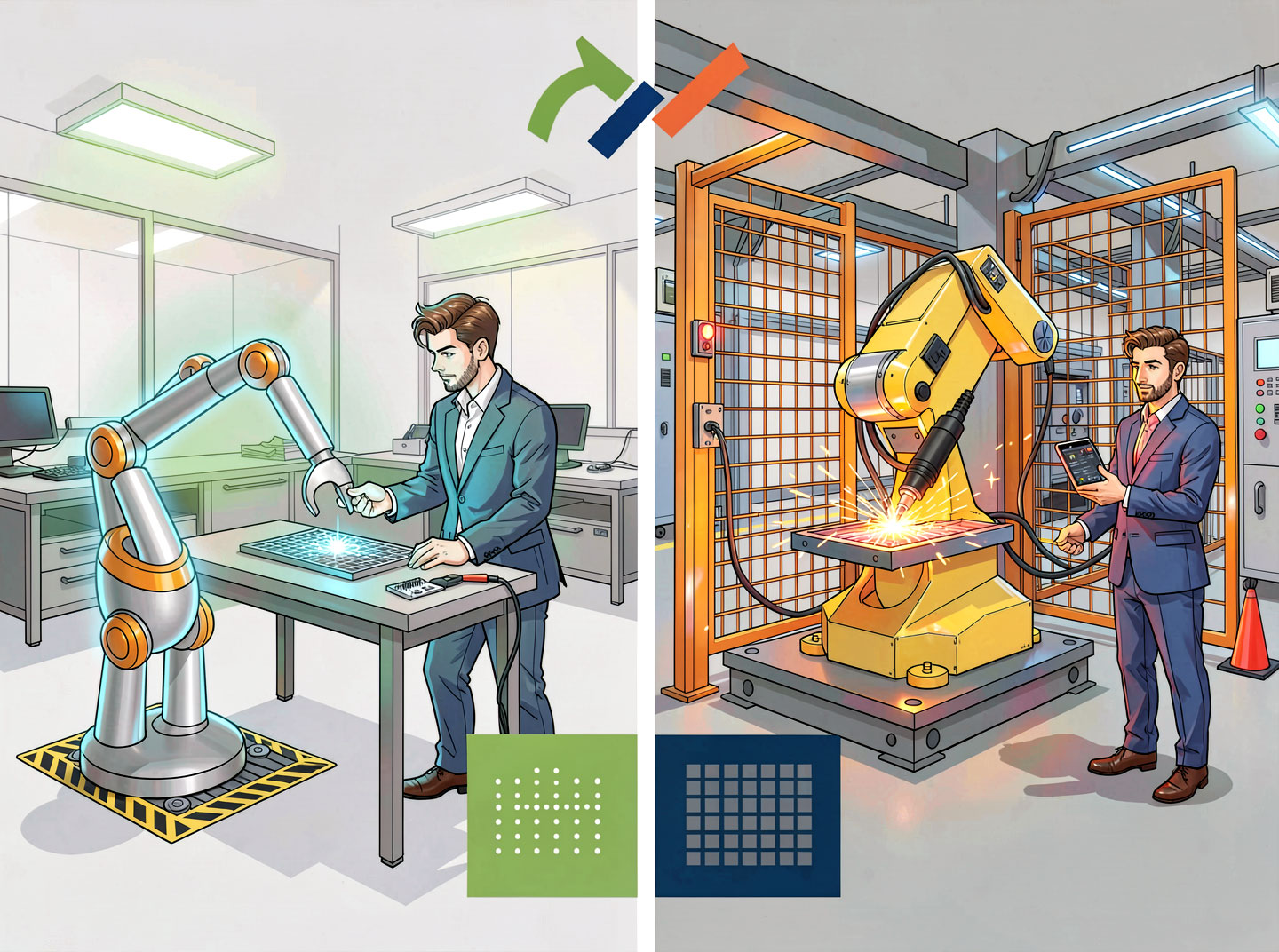
Collaborative robots and industrial robots are reshaping modern factory floors with advanced automation technologies.
What Are Collaborative Robots (Cobots)?
Collaborative robots, commonly called cobots, are designed to work alongside human operators without the need for safety cages or extensive guarding. Unlike their traditional counterparts, cobots are equipped with force-limiting joints, advanced sensors, and intelligent software that allows them to detect human presence and stop or slow down to prevent injury.
Cobots excel in flexible manufacturing environments where product variants change frequently and production volumes are moderate. They are typically lighter, easier to program, and quicker to deploy than conventional industrial robots.
What Are Traditional Industrial Robots?
Traditional industrial robots are high-speed, high-payload machines built for repetitive, heavy-duty tasks. You will find them welding car frames, assembling large components, and moving heavy materials across automotive, aerospace, and heavy manufacturing sectors.
These robots operate at full speed behind safety fences because their power and precision can pose serious risks to nearby workers. They require extensive integration, dedicated floor space, and longer implementation timelines.
Cobots vs Industrial Robots: Side-by-Side Comparison
FEATURECOLLABORATIVE ROBOTS (COBOTS)TRADITIONAL INDUSTRIAL ROBOTSSafetyBuilt-in force sensing; cage-free operationRequires safety cages, light curtains, or barriersProgrammingIntuitive, teach-by-hand, no coding neededComplex scripting, requires specialist engineersDeployment TimeHours to daysWeeks to monthsPayloadUp to ~25 kg typicallyUp to hundreds of kilogramsSpeedModerate (safety-limited)Very highFootprintCompact, mobileLarge, fixed installationsFlexibilityHigh; easy to redeployLow; designed for single tasksUpfront CostLower ($25K-$80K typical range)Higher ($100K+ with integration)Best ForFlexible manufacturing, small batchesHigh-volume, heavy-duty operations
Top Use Cases for Cobots in 2026
Collaborative robots are increasingly deployed for precision assembly, machine tending, and quality inspection tasks on modern production lines.
Cobots have moved far beyond pilot projects. Here is where they are delivering measurable results today:
Machine Tending
Cobots can load and unload CNC machines, injection molding equipment, and presses around the clock. When the batch changes, operators reprogram the cobot in minutes, not hours.
Assembly and Screw Driving
In electronics and consumer goods manufacturing, cobots handle delicate assembly tasks that demand consistency but do not justify full automation lines.
Quality Inspection
Equipped with vision systems, cobots perform repetitive inspection tasks with higher accuracy and less fatigue than human inspectors.
Packaging and Palletizing
Smaller facilities use cobots to automate end-of-line tasks without restructuring the entire production floor.
Welding Assistance
In metal fabrication, cobots assist skilled welders by holding torches steady, improving both quality and throughput.
Safety Standards You Need to Know
Understanding collaborative robot safety zones and ISO/TS 15066 compliance is essential for safe human-robot collaboration in manufacturing environments.
Safety is the defining factor that separates cobots from traditional robots. If you are considering collaborative robots, compliance with the following standards is non-negotiable:
ISO/TS 15066:2016
This technical specification defines safety requirements for collaborative robot systems, including force and pressure limits, workspace design, and hand-guiding protocols.
ISO 10218-1 and ISO 10218-2
These standards cover the safety requirements for industrial robots and robot systems, including both robot manufacturers and system integrators.
ANSI/RIA R15.06
The American National Standard for Industrial Robots and Robot Systems provides guidance on safe design, installation, and operation.
Risk Assessment
Even with cobots, a thorough risk assessment is mandatory. Factors such as end-effector design, workpiece edges, and cycle speed all influence the actual safety of the installation.
ROI Considerations: What the Numbers Really Say
When evaluating return on investment, look beyond the sticker price.
Total Cost of Ownership (TCO)
Cobots generally have lower TCO due to reduced integration costs, minimal safety infrastructure, and faster deployment. Industrial robots may offer higher throughput, but the savings must offset integration and guarding expenses.
Labor Cost Reduction
Both technologies reduce labor costs, but cobots uniquely address labor shortages in roles that are hard to fill or retain. A cobot working two shifts can often pay for itself within 12 to 18 months.
Downtime and Changeovers
In flexible manufacturing environments where changeovers happen daily, cobots reduce downtime significantly. Traditional robots require reprogramming by specialists, extending changeover windows.
Scalability
Cobots allow manufacturers to start small and scale incrementally. You can deploy one unit, validate the process, and add more without massive capital outlay.
The Rise of Robot as a Service (RaaS)
Robot as a Service (RaaS) enables manufacturers to deploy collaborative robots through affordable subscription models without large upfront capital investment.
One of the biggest trends shaping factory automation in 2026 is Robot as a Service (RaaS). This subscription-based model removes the barrier of large upfront capital expenditure.
Under RaaS, manufacturers pay a monthly fee that covers the robot hardware, software, maintenance, and technical support. Providers like Formic, Rapid Robotics, and traditional OEMs now offer RaaS packages for both cobot and traditional robot deployments.
Benefits of RaaS:
Preserves cash flow and working capital
Includes maintenance and software updates
Enables faster pilot-to-production scaling
Reduces risk for first-time automation adopters
For small and mid-sized manufacturers exploring factory automation for the first time, RaaS lowers the entry barrier and accelerates time-to-value.
How to Choose the Right Solution for Your Factory
Ask yourself these questions before making a decision:
Use this decision framework to determine whether collaborative robots, traditional industrial robots, or a hybrid approach best fits your factory automation needs.
What is your production volume?High-volume, long-run production favors traditional industrial robots. Low-to-medium volume with frequent changeovers favors cobots.
What is the payload and speed requirement?If you need to move heavy materials at maximum speed, traditional robots are the only viable option.
How much floor space do you have?Cobots require minimal space and no safety fencing. Traditional robots need dedicated cells with guarding.
Do you have in-house automation expertise?Cobots can be programmed by existing staff with minimal training. Traditional robots typically require robotics engineers or external integrators.
What is your risk tolerance?If you prefer to pilot automation before scaling, cobots or a RaaS model offer lower risk and faster validation.
Conclusion: The Future Is Collaborative, But Not Exclusive
In 2026, the question is no longer whether to automate. It is how to automate intelligently. Collaborative robots have earned their place as a legitimate automation solution for flexible manufacturing, quality control, and machine tending. They bring accessibility, safety, and speed of deployment that traditional robots cannot match.
The future of smart manufacturing lies in hybrid factory environments where collaborative robots and traditional industrial robots complement each other's strengths.
That said, traditional industrial robots remain unbeatable for heavy-duty, high-speed, large-scale production. The most advanced factories are not choosing one or the other. They are building hybrid environments where cobots handle variable, human-centric tasks and industrial robots manage the heavy lifting.
If you are ready to modernize your factory but unsure where to start, begin with a pilot cobot deployment in a single process area. Measure the results. Then decide whether to expand with more cobots or integrate traditional robotics for high-throughput operations.
The future of factory automation belongs to manufacturers who combine the flexibility of collaborative robots with the power of industrial robotics, delivered through models like RaaS that keep capital costs under control.