What Are the Three Types of Gateways? A Complete Guide for Network Engineers
In the world of computer networking, a gateway acts as a bridge between different networks that use dissimilar protocols. But not all gateways are the same. Depending on where they operate and what they translate, gateways fall into specific categories.
This article focuses on the three primary types of gateways you will encounter in modern network design. By understanding these three types, you can choose the right gateway for your home, office, or data center.
1. What is a Gateway? (Quick Refresher)

A gateway is a network node that connects two or more networks using different communication protocols, data formats, or architectures. It performs translation so that data can flow seamlessly from one network to another.
For example, a gateway can convert IPv4 packets to IPv6, or translate Ethernet frames to Wi-Fi signals. Without gateways, isolated networks would never be able to communicate.
2. The Three Main Types of Gateways
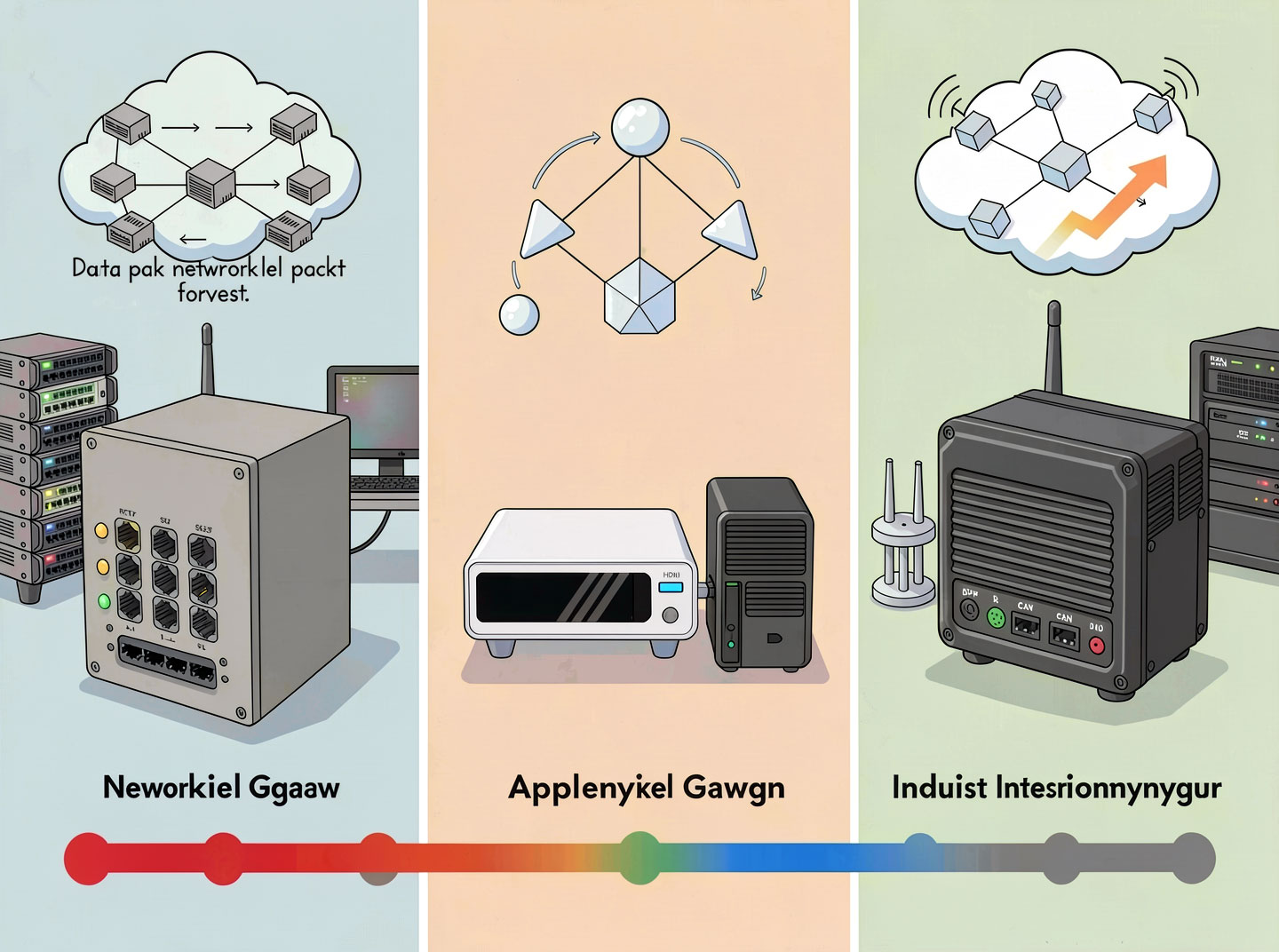
While many gateway subtypes exist, most fall into three broad categories based on their operating layer and primary function. Here is the list of the three core types:
Type 1: Network Gateway (Layer 3)

Also known as: Router-based gateway, default gateway, protocol converter (at network layer).
Where it operates: OSI Layer 3 (Network Layer).
What it does:
A network gateway connects two networks that may use different network-layer protocols (e.g., IPv4 and IPv6, or IPX and IP). In most home and small business environments, your router acts as a network gateway – it connects your local LAN to the internet.
Key characteristics:
Performs routing and packet forwarding.
Often includes Network Address Translation (NAT).
Handles IP address translation between subnets.
Can connect dissimilar network protocols (e.g., IPv4 ↔ IPv6).
Common examples:
Home broadband router (default gateway IP
192.168.1.1).Enterprise edge router connecting corporate LAN to ISP.
IPv6-to-IPv4 translation gateway (NAT64).
Use case: A company migrating from IPv4 to IPv6 uses a network gateway to allow IPv6-only devices to reach IPv4-only servers.
Type 2: Application Gateway (Layer 7)

Also known as: Proxy gateway, application-level gateway (ALG), API gateway.
Where it operates: OSI Layer 7 (Application Layer).
What it does:
An application gateway understands specific application protocols (HTTP, FTP, SMTP, etc.) and makes forwarding decisions based on the content of the messages. Unlike a network gateway, it terminates the incoming connection and establishes a new one toward the destination. This allows deep inspection and modification of application data.
Key characteristics:
Performs proxy functions – clients talk to the gateway, which then talks to the server.
Can cache, filter, or modify application payloads.
Provides security by hiding internal server details.
Often used for load balancing and authentication.
Common examples:
Web proxy server (e.g., Squid, Nginx) – filters HTTP traffic.
API gateway (e.g., Kong, AWS API Gateway) – manages microservices.
Email gateway – scans SMTP traffic for spam and malware.
Use case: A company exposes ten microservices. An API gateway (application gateway) provides a single entry point, handles authentication, rate limiting, and routes requests to the correct service.
Type 3: Cloud / IoT Gateway

Also known as: IoT gateway, cloud gateway, edge gateway.
Where it operates: Spans multiple OSI layers, often from sensor/physical layer up to application layer.
What it does:
A cloud gateway bridges on-premises devices or networks with cloud services. An IoT gateway aggregates data from sensors (Zigbee, BLE, LoRaWAN) and translates it into standard protocols (MQTT, HTTP) for cloud processing. These gateways are essential for edge computing.
Key characteristics:
Aggregates and pre-processes data from many devices.
Translates between low-power wireless protocols and IP networks.
Often includes local storage and analytics (edge intelligence).
Provides secure tunneling to cloud platforms (AWS, Azure, Google Cloud).
Common examples:
AWS Storage Gateway – connects on-prem storage to AWS S3.
Azure Virtual Network Gateway – connects on-prem network to Azure VNet.
Smart home hub (e.g., Samsung SmartThings) – bridges Zigbee/Z-Wave devices to Wi-Fi/Internet.
Industrial IoT gateway (e.g., Cisco IR series) – translates Modbus to MQTT.
Use case: A factory has hundreds of temperature sensors using Modbus. An IoT gateway collects the data, converts it to MQTT, and sends it to a cloud analytics platform – while also caching data if the internet goes down.
3. Comparison Table: Three Types of Gateways
FeatureNetwork GatewayApplication GatewayCloud / IoT GatewayOSI LayerLayer 3 (Network)Layer 7 (Application)Multiple (often L2–L7)Primary functionRoute/translate between networksProxy, filter, modify app dataBridge devices/on-prem to cloudProtocol exampleIPv4 ↔ IPv6HTTP ↔ HTTPS, SMTP filteringZigbee ↔ MQTT, SMB ↔ S3Security roleNAT, basic ACLDeep packet inspection, authenticationEncryption, tunneling, device authTypical deploymentRouter, edge deviceProxy server, API gatewayEdge gateway, cloud connectorPerformance impactLow (fast forwarding)Medium to high (terminates connections)Varies (depends on data aggregation)
4. How to Choose the Right Gateway Type for Your Network
Selecting among the three types of gateways depends on your network needs. Use this decision list:
Need basic connectivity between two different networks? → Choose a Network Gateway (e.g., router with NAT64).
Need to inspect, filter, or authenticate application traffic? → Choose an Application Gateway (e.g., reverse proxy, API gateway).
Need to connect local devices/sensors to a cloud platform? → Choose a Cloud / IoT Gateway.
Have mixed requirements? You can chain them – for example, an IoT gateway forwards data to an application gateway for authentication, then to a network gateway for routing to the internet.
5. Other Notable Gateway Types (Bonus List)
Beyond the three main categories, here are additional gateway types you may encounter:
Gateway TypePurposeVoIP GatewayConverts between traditional telephone (PSTN) and VoIP networks.Payment Gateway(Non-networking) – Processes credit card transactions between merchant and bank networks.Media GatewayTranslates between different media formats (e.g., H.264 to H.265) in video networks.Email GatewayFilters and routes email between internal mail servers and the internet.Wireless GatewayConnects wired and wireless networks (e.g., cellular to Wi-Fi).Storage GatewayTranslates block/file storage protocols to cloud object storage (e.g., iSCSI to S3).
Most of these are specialized variants of the application or cloud gateway categories.
6. Frequently Asked Questions
Q1: Is a router a gateway?
Yes. A router is a common example of a network gateway (Type 1). It connects your local network to other networks (like the internet).
Q2: Can one device act as all three types of gateways?
Sometimes. A unified threat management (UTM) appliance can route (network gateway), proxy HTTP (application gateway), and connect to a cloud management portal (cloud gateway). However, dedicated gateways perform each role better.
Q3: What is the difference between an application gateway and a firewall?
A firewall blocks traffic based on IP/port rules. An application gateway understands the application data (e.g., HTTP headers) and can allow/deny based on content – it is a more advanced type of firewall often called a next-generation firewall (NGFW).
Q4: Do I need an IoT gateway if I have Wi-Fi?
Yes, if your IoT devices use protocols like Zigbee, Z-Wave, or LoRa (which Wi-Fi does not speak). The IoT gateway translates those protocols to IP.
Q5: Which gateway type is best for microservices?
An API gateway – which is a subtype of application gateway (Type 2). It handles routing, authentication, rate limiting, and aggregation for dozens of microservices.
7. Conclusion

Gateways are the glue that holds modern networks together. By understanding the three types of gateways – Network Gateway (Layer 3), Application Gateway (Layer 7), and Cloud / IoT Gateway – you can design networks that are interoperable, secure, and scalable.
Quick recap list:
Network Gateway – Connects dissimilar network-layer protocols (e.g., IPv4 to IPv6).
Application Gateway – Inspects and proxies application traffic (e.g., HTTP, email).
Cloud / IoT Gateway – Bridges on-prem devices/sensors to cloud platforms.
Whether you are setting up a home router, securing a corporate web server, or deploying a smart factory, one of these three gateway types will be at the heart of your solution. Choose wisely, and your network will thank you.