Hybrid stepper motor vs stepper motor – a detailed comparison
Introduction

Engineers often encounter the term “stepper motor” as a broad category, but within that category lies the superior hybrid stepper motor. This article compares hybrid stepper motor vs stepper motor – specifically contrasting the hybrid design with the two main traditional stepper motor types: permanent magnet (PM) and variable reluctance (VR). By the end, you will know exactly which type suits your application.
Defining the Comparison Groups
A stepper motor is any electric motor that moves in discrete steps. The three common subtypes are:
Permanent magnet (PM) stepper motor – Rotor is a permanent magnet.
Variable reluctance (VR) stepper motor – Rotor is soft iron with teeth; no magnet.
Hybrid stepper motor – Combines both technologies.
Thus, “hybrid stepper motor vs stepper motor” essentially means comparing the hybrid to the other two designs.

Comparison #1: Construction
PM stepper motor
Rotor: cylindrical permanent magnet with alternating N/S poles on the surface.
Stator: wound poles with no teeth (or coarse teeth).
VR stepper motor
Rotor: toothed soft‑iron stack (no magnet).
Stator: toothed poles.
Hybrid stepper motor
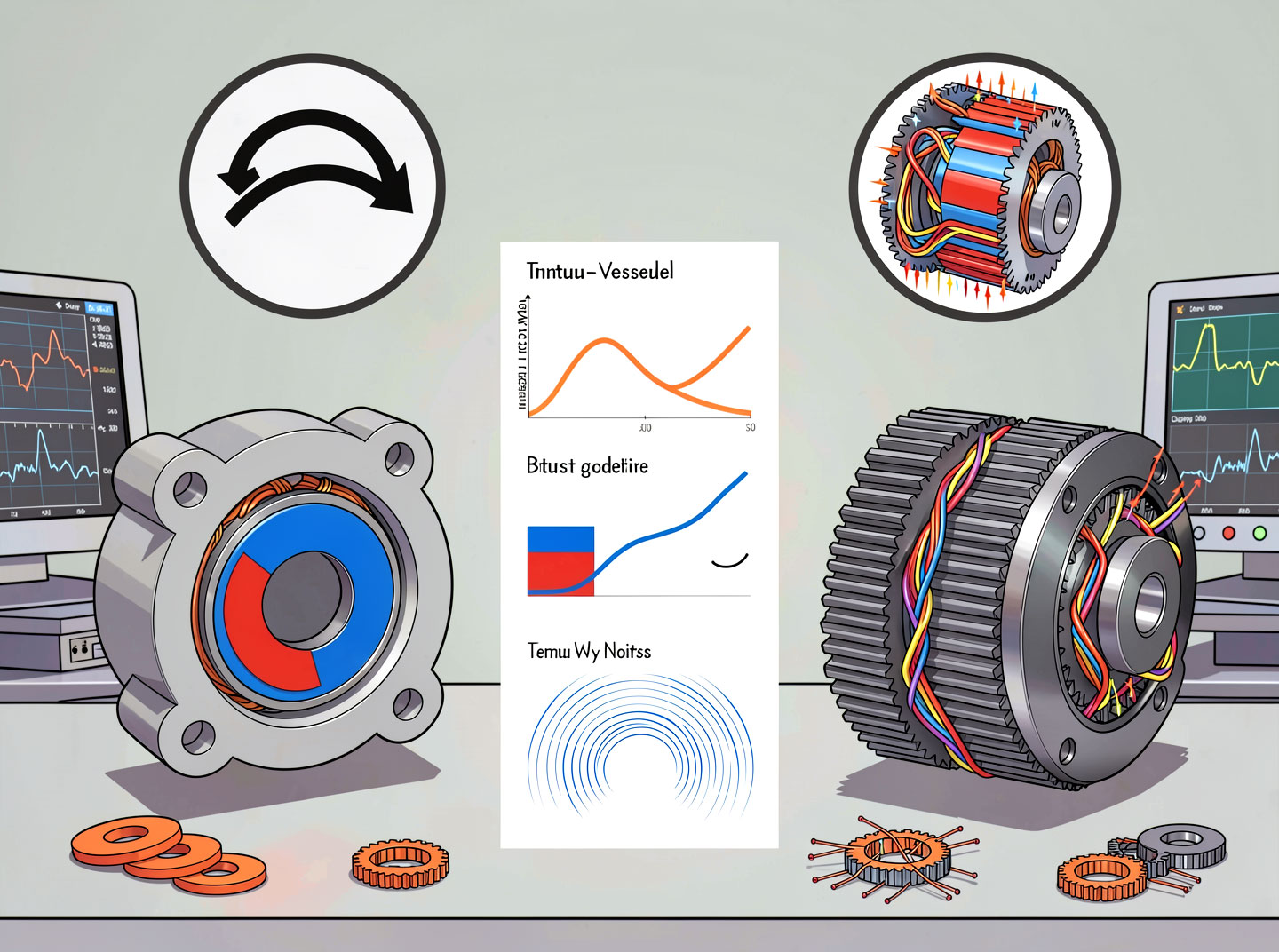
Rotor: two toothed cups separated by an axial permanent magnet.
Stator: finely toothed poles.
The hybrid stepper motor has the most complex rotor, which is why it achieves the finest step angles.
Comparison #2: Step Angle and Resolution
TypeTypical step angleSteps per revolutionPM stepper motor7.5° – 15°24 – 48VR stepper motor5° – 15°24 – 72Hybrid stepper motor0.9° – 1.8°200 – 400
A hybrid stepper motor can also be microstepped (e.g., 1/16, 1/32 step) to achieve even higher effective resolution, while PM motors are less responsive to microstepping.
Comparison #3: Torque Characteristics
Holding torque – Hybrid stepper motors offer the highest holding torque for a given frame size.
Dynamic torque – Hybrid design maintains torque better at speeds up to 1000–2000 RPM, whereas PM torque drops sharply beyond 300 RPM.
Detent torque (unpowered) – PM motors have significant detent torque (cogging); hybrid motors have very low detent torque; VR motors have none.
Typical torque comparison (NEMA 17 size, 0.5 N·m rated):
PM stepper motor – Holding torque ~0.2 N·m; torque at 500 RPM <0.05 N·m.
Hybrid stepper motor – Holding torque ~0.4 N·m; torque at 500 RPM ~0.2 N·m.
Comparison #4: Control and Drive Electronics
FeaturePM stepper motorVR stepper motorHybrid stepper motorDrive voltage5 – 12 V (often unipolar)12 – 48 V (bipolar or unipolar)12 – 70 V (bipolar preferred)Microstepping supportLimitedModerateExcellent (smooth motion)Current controlNot criticalImportantEssential (chopper drives)
Because the hybrid stepper motor has a more complex magnetic circuit, it requires bipolar chopper drivers for best performance. However, many off‑the‑shelf stepper motor drivers (e.g., TMC2209, A4988) are designed specifically for hybrid stepper motors.
Comparison #5: Cost and Availability
PM stepper motor – Lowest cost; used in low‑end toys, automotive gauges.
VR stepper motor – Rare today; obsolete in many applications.
Hybrid stepper motor – Moderate cost; widely available; dominates industrial motion control.
Despite higher upfront cost, the hybrid stepper motor offers better long‑term value due to reliability and precision.
When to Choose Each Type?
Choose a permanent magnet stepper motor when:
Step angle >7.5° is acceptable.
Low cost is the priority.
Torque at high speed is not required.
Example: simple rotating display, low‑cost pump.
Choose a variable reluctance stepper motor when:
You have a legacy system.
Very low inertia is needed (no magnet in rotor).
(Rarely used today.)
Choose a hybrid stepper motor when:
You need step angles ≤1.8°.
High torque at moderate speeds (500–2000 RPM) is required.
Smooth motion and low vibration matter.
You are using microstepping.
Example: 3D printer, CNC, robotics, medical devices.
Real‑World Performance Example
Consider a desktop CNC milling machine:
With PM stepper motor: Step angle 7.5° → 48 steps/rev → resolution 0.1 mm/step (poor). Torque drops at 200 RPM causing missed steps.
With hybrid stepper motor: Step angle 1.8° → 200 steps/rev → resolution 0.025 mm/step (good). Torque holds up to 800 RPM, enabling faster machining.
This example clearly demonstrates why hybrid stepper motor vs stepper motor (PM type) is no contest for precision applications.
Summary Table – Hybrid Stepper Motor vs Stepper Motor (PM & VR)
ParameterPM Stepper MotorVR Stepper MotorHybrid Stepper MotorRotor magnetYesNoYes (axial)Teeth on rotorNoYesYesStep angle (typical)7.5° – 15°5° – 15°0.9° – 1.8°Holding torqueLowMediumHighHigh‑speed torqueVery lowLowMedium‑highDetent torque (unpowered)HighZeroLowCost$$$$$ – $$$Typical applicationGauges, fansObsolete3D printers, CNC
Conclusion
When comparing hybrid stepper motor vs stepper motor (the broader category), the hybrid version is almost always superior in resolution, torque, and control. The only reasons to choose a basic PM stepper motor are extreme cost reduction or very undemanding applications. For any modern motion control system requiring precision, the hybrid stepper motor is the standard.